Solar Drying Machines for Modern Agricultural and Food Processing Applications
Wiki Article
Introduction
Post-harvest handling is an important part of agricultural business. Producing a crop is only the beginning. Farmers and processors must also decide how the harvest will be cleaned, stored, transported, processed and eventually sold.
Drying can be an important option for suitable products. Solar drying technology provides an enclosed way to use solar heat for moisture reduction while creating a more organised processing environment.
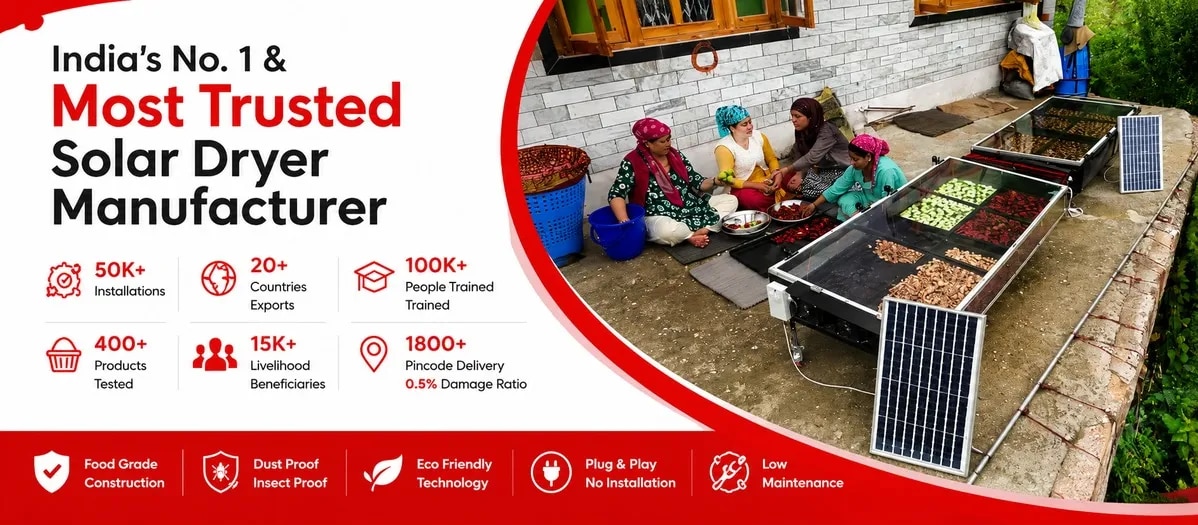
Rudra Solar Energy supplies solar dryers across India and states that its systems are used by farmers, SHGs, FPOs, rural entrepreneurs and commercial processors.
Why Post Harvest Drying Is Important
Fresh produce contains water. Depending on the crop, this moisture can influence handling and storage requirements.Drying reduces moisture and creates a different form of the product. The intended final condition should be established according to the commodity and application.
Open Sun Drying
Open-sun drying is simple and requires little specialised equipment. However, the product is exposed to the outdoor environment.Weather can change during the drying period, and the product may also be exposed to dust, insects and birds.
Enclosed Solar Drying
An enclosed solar dryer places the material inside a chamber. Rudra Solar Energy describes this approach as helping reduce direct exposure to dust, insects, birds and sudden rainfall. :contentReference[oaicite:49]index=49Solar Drying as a Processing Step
Drying can be incorporated into a wider post-harvest workflow.A general sequence might include:
- Harvesting
- Sorting and grading
- Cleaning
- Preparation
- Drying
- Cooling
- Packaging
- Storage
The exact sequence depends on the commodity.
Products Suitable for Solar Drying
Rudra Solar Energy lists many suitable applications, including fruits, vegetables, spices, herbs, grains, pulses, oilseeds, seeds and flowers. :contentReference[oaicite:50]index=50Multi Commodity Processing
A multi-commodity system can be useful where an organisation handles different crops during different seasons.However, each product needs its own drying process. Operators should avoid assuming that the same temperature, loading and duration will work for all commodities.
Reducing Dependence on Conventional Energy
Solar dryers can be relevant to businesses currently using LPG, diesel, electricity or other conventional thermal energy for drying.Rudra Solar Energy states that its solar dryers are intended to reduce dependence on such energy sources where they are currently used.
The actual financial effect depends on how much conventional energy was previously consumed, the dryer capacity, operating frequency and local conditions.
When Replacing Open Sun Drying
If the existing process already uses open sunlight without fuel, the primary advantage may not be fuel savings. Instead, an enclosed Solar Dryer Supplier system may provide more organised handling and protection from Solar Dryer In India outdoor exposure.This distinction is important when evaluating a potential investment.
Planning for Farmers and FPOs
Farmers and FPOs should begin by calculating how much fresh material they actually have available.Rudra's agricultural dryer range covers configurations from 5 kg per batch to 500 kg per batch.
Questions to Answer
Before purchasing equipment, organisations can consider:- Which crops will be processed?
- What is the peak seasonal quantity?
- How much material is available per batch?
- How many batches are required?
- What final product is desired?
- Where will packaging occur?
- What space is available?
- Is backup heating required?
Location and Solar Availability
A solar dryer needs appropriate solar exposure. The installation site should also allow easy loading and unloading.Rudra Solar Energy states that its systems are supplied to rural, remote, hill, high-altitude and off-grid locations across India, with model selection based on location and application.
Quality Control
Post-harvest processing should include quality checks. Operators should Website monitor the material during drying and verify that the final product meets the intended condition.The product should then be cooled and packaged appropriately.
Why Storage Matters
Drying does not eliminate the need for proper storage. A dried product can absorb moisture if it is exposed to humid conditions.Suitable packaging and storage practices should therefore be considered as part of the drying project.
Conclusion
Solar drying can become a useful component of post-harvest processing for suitable agricultural products. It provides an enclosed alternative to open-sun drying and uses solar thermal energy for moisture reduction.Rudra Solar Energy offers systems for farmers, FPOs, SHGs and commercial processors, with different capacity configurations and application-specific models.
The technology should be evaluated as part of the complete agricultural value chain. Product suitability, capacity, preparation, hygiene, packaging, storage, market requirements and actual energy use all need to be considered. When these elements are planned together, solar drying can support a more organised approach to agricultural value addition.
 Report this wiki page